Updates from the MBA

It’s been a while since my last post, so sharing an update on what I’ve been working on recently and a few places where my writing and work have been showing up.

As I wrap my first year of my MBA candidate at Columbia Business School, I’ve been spending most of my time focused on building advanced finance and leadership capabilities while learning about climate investing and technology, real estate and infrastructure, and social enterprise. It’s been a really interesting mix of academic work, practical projects, and conversations that sit at the intersection of markets, policy, and long-term investment strategies. Also an amazing opportunity to meet and learn from new people and, of course, travel!

Along the way, I’ve had the opportunity to contribute to a few different platforms and organizations, working with incredible students, faculty, and Columbia team members.

Having joined a number of student initiatives and organizations, I am excited to be taking on the role of Vice President in my second year for both the Energy and Infrastructure Club and the Social Enterprise Club, where we work closely with the Tamer Institute for Social Enterprise and Climate Change to promote aligned initiatives across the school. I’ll also continue my current role as a member of The Hub‘s Student Advisory Board, CBS’s ‘thinktank’ driving thought leadership at the intersection of policy and business across the school.

A highlight was getting to know a series of incredible leaders in social enterprise by partnering with Professor Horton, Sandi Wright, the Tamer team, and my wonderful co-student producer Sofia to create Season 2 of the MoreMPE podcast. It was a great opportunity to step back and think more broadly about how entrepreneurship and investing can come together to drive impact globally and locally. Especially proud of the work for our capstone live event and episode, Catalysts for Change, where hundreds of students, alumni, and practitioners joined us to hear from 8 of our season’s guests on how they are navigating leadership and social enterprise in their careers.

Outside of school, my professional background and other work are reflected in a few different places, including professional updates on my LinkedIn and past riding on my YouTube. Some of my older writing can also be found at the Stanford Daily, where I was a staff writer back in the day. More links can also be found on my “Contact” page.

I’ll aim to continue to add to this over time as things evolve. Lots more to share about my time at CBS, including work from many classes including our Generative AI for Business RiskWatcher product – built end-to-end with AI – and research from my climate classes, but better something than nothing for now!

Budapest Wanderlusting

Budapest, Hungary’s enchanting capital, offers a mix of history, vibrant culture, stunning architecture, and relaxing hot springs. Whether you’re walking along the Danube or exploring the city’s ruin pubs, Budapest delivers an unforgettable experience. Here’s your ultimate guide to making the most of your visit.


Where to Stay

We stayed in an Airbnb in Mikszáth Kálmán tér (District VIII), on the Pest side of the city—a perfect location for travelers. Staying on the Pest side is highly recommended for its accessibility to metro stations, tram lines, and attractions like the Central Market Hall. Our accommodation was steps away from Kálvin Tér Metro Station, restaurants, bars, and major sites, making it ideal for exploring the city.

For a cozy and central stay, consider options near the Central Market Hall or Deák Ferenc Tér, the main metro hub. If you’re traveling with a group, many spacious Airbnbs are available in this area. For more recommendations, check out The Culture Trip’s top places to stay.


Getting Around

From the Airport

The easiest way to reach the city is via the airport bus, which connects to the metro at its final stop. From there, take the metro into town. Simple and cost-effective!

Public Transportation

Consider purchasing the 48-hour Budapest Card, which includes free public transport and discounted entry to museums and attractions. Alternatively, opt for a 2- or 3-day transport card, which covers unlimited travel on the metro, buses, and trams. The city’s grid pattern and efficient public transport system make navigation a breeze—we didn’t need a cab the entire trip.


Top Things to Do

Day 1: Explore the Danube and Central Market

  • Morning Stroll Along the Danube: Start at Deák Ferenc Tér and walk north along the river. Admire stunning views of the Buda side, including landmarks like the Fisherman’s Bastion and Castle Hill. End your walk at the iconic Chain Bridge.
  • Holocaust Memorial and Market: A short walk from the Chain Bridge, the Holocaust Memorial is a poignant site. Behind it, explore a lively market with delicious food, live music, and unique souvenirs.
  • Central Market Hall: Dive into Hungarian cuisine and pick up local treats. This historic covered market is perfect for shopping and sampling traditional dishes.

Nearby Attractions

  • St. Stephen’s Basilica: A 10-minute walk southeast.
  • Parliament Building: A 15-minute walk northwest.
  • Great Synagogue: A 15-20 minute walk south.

Evening at the Opera House

Even if you’re not an opera fan, the Hungarian State Opera House is worth visiting for its breathtaking architecture. If possible, catch a performance—tickets are surprisingly affordable.


Day 2: Discover the Buda Side

  • Chain Bridge to Castle Hill: Cross the Chain Bridge and hike up to Castle Hill, or take the charming funicular. At the top, visit:
    • Buda Castle and National Gallery: Climb to the dome for the best panoramic view of Budapest.
    • Matthias Church and Fisherman’s Bastion: A fairy-tale-like site with stunning architecture and views.
  • Dracula’s Tunnels: If you’re intrigued by legends, explore the underground tunnels where Dracula was said to be held. A unique and eerie experience awaits.

Evening Relaxation: Hot Springs

After a day of walking, unwind in Budapest’s famous thermal baths. We visited a large, historic bathhouse at night—the warm water under the stars was magical. Bring a towel, sandals, and swimwear. For a livelier vibe, explore one of the trendy, music-filled bath parties.


Must-See Spots

  • Andrássy Avenue: Stroll this UNESCO World Heritage Site, which ends at Heroes’ Square and the City Park. The avenue’s museums and gardens are perfect for culture enthusiasts.
  • Ruin Pubs: Budapest’s iconic nightlife scene includes spots like Szimpla Kert, a quirky, partially underground bar with a fun (though not musical) vibe.

Food and Drink Recommendations

  • Muzéum Café & Restaurant: Excellent Hungarian cuisine with a fancy yet affordable vibe.
  • Pata Negra Tapas Bar: A cozy Spanish restaurant with great food.
  • Stex Ház: A laid-back spot for hanging out with friends and enjoying decent food.

Insider Tips

  • Budapest is a walkable city where you can stumble upon stunning architecture. Take time to wander!
  • Stay near a metro stop, ideally on the Pest side for easy access to attractions.
  • Don’t miss the hot springs and ruin pubs for a quintessential Budapest experience.

Budapest’s charm lies in its blend of old-world elegance and modern vibrancy. From the picturesque Buda side to the lively Pest side, this city has something for everyone. Pack your walking shoes and prepare to fall in love with Budapest!

A Review of the Turkish Referendum

Around two weeks ago, the Turkish people voted in support of changing a portion of their constitution in order to grant President Erdogan’s additional, far-reaching powers in the government.

The referendum in its totality has been under some harsh scrutiny since it was passed, including due to ballots tallied without official stamps or markings. Some opposition parties in Turkey are in favor of this referendum’s annulment for reasons such as voter fraud, the transformation of the Prime Minister’s office, and the changes allowing Erdogan to possibly remain president until 2029. The main opposition parties, in conjunction with civil liberty groups, have provided evidence that fraudulent votes account to around 2 million.

With a narrow victory of 51.4%, there is no doubt that the country is deeply divided about the referendum itself, and will likely stay that when when its outcomes become apparent.

For many Turks, this public vote is seen as giving the president more power, with potential to allow for additional economic growth and development. Most opposition parties firmly believe that this referendum is a sudden means to acquire more power and secure Erdogan’s position without the influence of outside forces. This is quite the contrast with Erdogan’s supporters who see the changes as effective government-based alternatives to secure a more stable, prosperous financial future for Turkey.

Tana de Zulueta, who is currently the head of the OSCE Office for Democratic Institutions and Human Rights, has recently released a report stating that the opposition campaign was muted and the media coverage has been stilted.

More importantly, Zuleta confirmed that the electoral authority’s decision to accept unauthorized ballots resulted in a legal contradiction, changing the validity criteria. This public vote signifies the first time that Erdogan has actually lost the majority in large cities such as Istanbul, Ankara, and Izmir.

The recent changes will see the removal of the prime minister position, with those responsibilities transferred over to the president. Minimizing the role of the prime minister has been an ongoing discourse for some time now, but the referendum will structurally alter how power is handled in both positions. Especially since becoming President, Erdogan has made it clear that he strongly supported a presidential system that would include extensive executive authority.

With regard to appointing Supreme Court members, the vote has also altered the number of members the president can appoint from 4 out of 22 to nearly half (5 out of 13). Unlike before when the president was not permitted to have any political affiliations under the constitution, the new referendum would allow the president to align with a political party.

Another main area in which Erdogan will have additional power will be circumventing parliament when it comes to regulating ministries and handling senior civil servants. While the president would be unable to alter or modify decrees related to human rights or freedoms, he will have the ability to bypass the cabinet, declaring a state of emergency.

In terms of legally repealing the referendum, lawmakers from the CHP (the Republican People’s Party) have recently appealed to the European Court of Human Rights, asking to provide insight into this divisive public vote. Only time will tell if there will be any legal amendments or further recourse as a result of these appeals in the weeks to come.

Rehabilitating Racehorses

For those looking for their next horse, be it for casual rides or competitive show jumping, racetracks can be an interesting place to find athletic thoroughbreds (and sometimes other breeds) with capabilities that can make them excellent performers. For a variety of reasons, ex-race horses are often available to be purchased or even rescued from the tracks or from an animal shelter for minimal cost.

In considering this, it is important to recognize that the racehorse industry has many less-than-ideal characteristics. Horses may be subject to abusive situations, including being forced to run on potentially crippling injuries, doping, and questionable or illegal training practices. While many racing trainers and jockeys are ethical and care about their horses, the possibility that a racehorse has been retired from racing due to irreparable damage (physical and/or psychological) is an important warning for anyone considering this route. However, you may find an incredible talent, or have the opportunity to save a horse’s life and create a new future for them by finding them from the tracks.

By buying or rescuing a retired racehorse, you are potentially finding a gem, or potentially giving an exhausted, wounded, or abused animal a loving home. Sadly, to this day many thoroughbreds end up being slaughtered rather than being rehomed; the vast majority of horses raised for racing do not make it at a level that sponsors find worth sustaining. Yet many racehorses take very well to other riding disciplines with the right training, patience, and (if needed) rehabilitation.

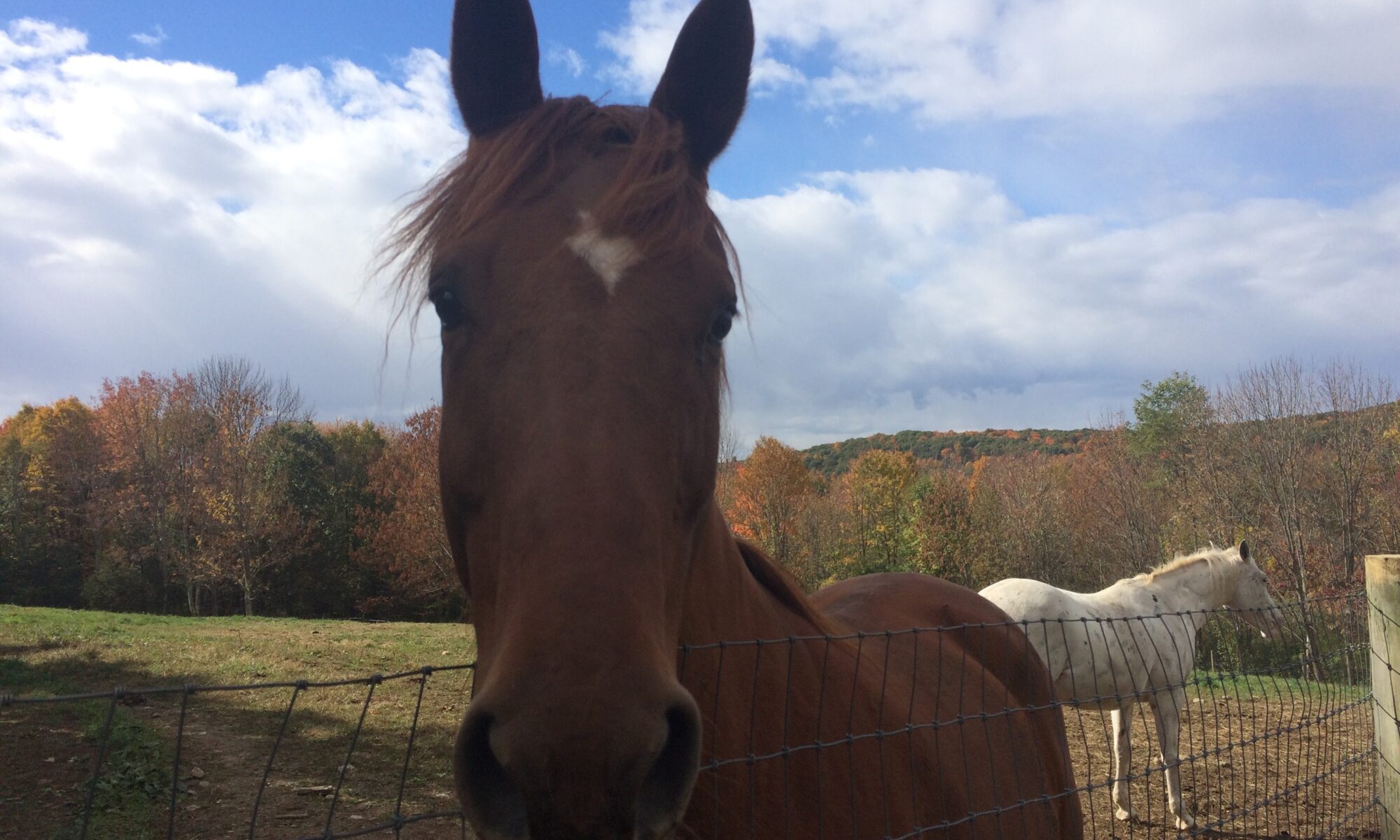
My family had the opportunity to adopt three horses that were associated with the racing industry some years ago. They were not ex-race horses themselves, but were caught up in a terrible racing-related nurse-mare scheme, the dismantling of which meant that dozens of foals and mares needed immediate care and re-homing right before the NY winter. We took in a mare and two foals, and over the next three years, worked with them to build back their trust and confidence. I’m so proud of how well they have done since. Both the mare, Alaska, and the foal, Charlemagne (Charlie), stayed with us for some time until we could train them under saddle and ultimately find them happy pleasure and cross-country riders – that’s Charlie’s nose in the picture and Alaska in the background! The little filly we took in was fortunately in better shape than the other two, and as a beautiful mover, she joined a Hunter program within a year of coming to our farm, and has since thrived.

This journey is not dissimilar to that you may expect from working with an ex-racehorse, though of course I would not pretend to draw direct parallels. It may take some time for your ex-racehorse to be ready to ride, especially if they come straight from the track. They may be too fit and run too fast for most riders, needing some time to come down from the pressure and intensity of their past work. If they were being illegally doped, they may need to literally come down, as well. Especially given the age at which many racehorses are started, you may well be best giving them a few weeks, months, or even longer to just ‘be a horse’ and enjoy turnout while you begin to gradually work with them to adjust to training for a new discipline.

When you get underway, you’ll need to remember that their training likely looks very different from non-racehorses you may have worked with in the past. Passing along below some tips to remember if you find yourself taking this route, which comes from the website Retraining of Racehorses, a resource which may be helpful for more information.

  • Be realistic about your ability and experience and don’t be afraid to seek advice (they offer the RoR Helpline as just a call or email away)
  • Generally a former racehorse is good to load, clip, stands for the farrier and has good stable manners.
  • The horse will not be accustomed to being tied up outside his stable so is likely to fidget and become anxious.
  • Racehorses are generally not accustomed to standing still when mounted because lads and lasses are generally legged up whilst the horse is walking.
  • The horse is used to being ridden but not in quite the same way as a riding horse. Some of the aids are different, indeed quite the opposite, to what he is used to and you are accustomed to applying in a given situation.
  • The horse may not be used to anyone riding with long stirrups although this is much less likely these days; it is more the placement of the lower leg if initially drawn too far back that a horse can react to.
  • Your braking system could well be limited; and when you shorten up the reins and undoubtedly, although probably unintentionally, incline yourself forward, you are actually giving cues to go faster!
  • The horse will know little about contact in terms of how we understand it for the riding horse so when you pick up the reins, the head and neck will invariably go up and out rather than low and rounded. You may also experience head tossing and snatching at the bit.
  • The horse will be used to riding out in company which means that hacking out on your own you could encounter problems in relation to insecurity. Riding in company can also present its own issues as will be associated with work ie. a training gallop.

Beasts of No Nation

Beasts of No Nation is a motion picture by Cary Fukunaga. And when I say “by”, I mean that every aspect of this film has his fingerprints. With experience in both film and television (with credits on everything from Jane Eyre to True Detective), Cary Fukunaga clearly set out to realize his vision in this binding production. He was writer, director, cinematographer, and even cameraman when a leg injury prevented the cameraman from continuing to shoot the film.

A film about a young boy who is drafted into being a child soldier in a horrific war, the film is based of of the Uzodinma Iweala book of the same name. Cary Fukunaga researched child soldiers and the Sierra Leone Civil War for six years before coming across the electric-prosed novel. “I read through the novel and I loved the elegant and concise way that Uzodinma Iweala told the story.” Fukunaga said, “I felt that would be the best way to enter the subject.”

Fukunaga was clearly avoiding making Beasts of No Nation an “issue movie”. There is no specific, based-on-a-true-story conflict. There is no one place or time that this story takes place. He does not seem to seek to educate you and impassion you into action for a specific cause. This movie, instead, is about the emotional damage that is suffered by child guerrilla fighters worldwide. The spiritual conflict that lies within growing up witnessing (and committing) these atrocities, and how that affects the young, is the central idea of this film.

Fukunaga is aware of the emotional toll this takes on viewers. “No one’s gonna want to watch it, even if they hear it’s a good film,” he said before the release, noting how tough it is to persuade people “to make the time to watch something that’s emotionally taxing.”

Perhaps the most notable thing about Beasts of No Nation is that it may well be a model for future distribution. In an ever-changing media climate, how we will and how we will want to consume our entertainment is never a certainty. This film is the first fictional feature distributed by Netflix. They purchased the rights for distribution worldwide for $12 million. It was the first film to be released the same day on Netflix and in theaters. Considering this simultaneous release a violation of the unregulated but standard 90-day-release window that usually gives cinemas exclusivity, the four largest theatre chains in the United States (Cinemark, AMC, Regal, and Carmike) announced that they would be boycotting the film. Released by smaller cinemas and independent chains, the opening box office was less than stellar.  

Netflix, however, isn’t complaining. According to Netflix chief content officer Ted Sarandos, that doesn’t matter. Although historically Netflix never shares and, in fact, closely guards its streaming numbers, Sarandos revealed that the movie has already gotten 3 million views in North America. “I think [that] is a bigger audience than any specialty film could ever hope for in its first two weeks of release, and maybe for its entire run,” Sarandos told Deadline. “We are just thrilled with the total audience reach of this film, not just in North America but the world. In the first week of release, Beasts of No Nation was the most watched movie on Netflix, in every country we operate in.”

This change in distribution was certain to challenge the Academy of Motion Picture Arts and Sciences’ definition of what a movie actually is. What kinds of filmed entertainment should qualify for Oscar noms is a constantly-moving line that is getting blurrier every day. With made-for-TV movies, streaming services like Netflix, and DIY films and webseries letting filmmakers adhere to ANY rules, quality content and history-making releases are happening more and more with less and less ability to fit into the Academy’s mould.

Though Netflix was certainly pushing for Oscar recognition with Beasts of No Nation, no nominations were received in any category, yet.

Though it did not get a nod from the Academy, Rotten Tomatoes, a ratings and review site with a notoriously critical eye, has given it a rating of 91%. So, though Cary Fukunaga knows it will be hard for you to get yourself to watch it, I recommend you see Beasts of No Nation. And if not simply for the important story it tells – one that is so often hidden from our screens – watch it because it is part of the way filmmakers are changing the entertainment industry every day.